On Student Evaluations
Whether student evaluations of teaching are useful remains a contested question in higher education. Since students are uniquely positioned to comment on their learning experience: they observe the instructor regularly, experience the course structure firsthand, and can assess clarity, organization, and engagement; in this limited sense, they might be competent judges of how a course is delivered. On the other hand, students are less well equipped to judge what is taught at a deep level, such as the intellectual rigor of the material, its alignment with disciplinary standards, or its long-term educational value. Simply put, what students lack is vision. Or as Dunning-Kruger effect would have it: they don’t know what it is that they don’t know.
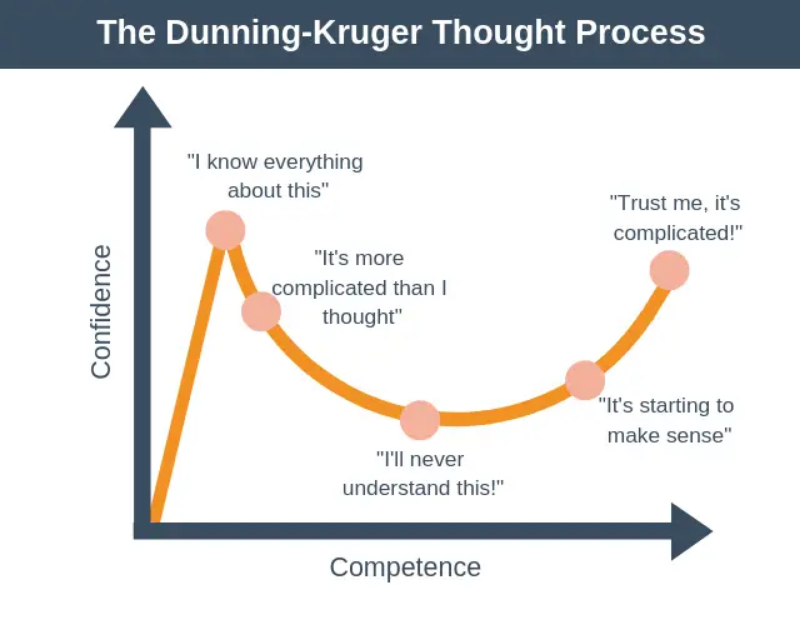
This raises a fundamental concern: student evaluations may capture satisfaction and experience more reliably than actual teaching effectiveness or learning outcomes.
Does Technique Trump Content?
The Dr. Fox Effect (see video below) is frequently cited to support skepticism toward student evaluations. In the original study by Naftulin, Ware, and Donnelly (1970), an actor posing as an expert delivered a lecture that was confident, fluent, and entertaining but intentionally lacking in substantive content. Despite this, participants rated the lecture and instructor very positively. The study demonstrated that expressive delivery and apparent authority can strongly influence evaluations, sometimes overriding the absence of meaningful intellectual content. This effect suggests that students may conflate performance, charisma, and confidence with genuine expertise and effective teaching.
While influential, the conclusions often drawn from the Dr. Fox Effect warrant caution. The sample was small, the setting artificial. And it may not necessarily be the case that a teacher’s style triumphs over his substance over a long length of time. It therefore exaggerates the ease with which poor teaching can be disguised over longer periods. Moreover, many later studies indicate that student evaluations are multidimensional: while they are sensitive to presentation style, they also reflect course organization, clarity, and perceived learning when properly designed.