Quasiparticles and Fermi Liquid Theory
One accusation laid against utopian views of society (communism, anarchism) or utopian views of humans (objectivism) is that the system they describe is unrealistic. That people do not lead the idealized lives that a theorist would have you believe in the tomes that he or she has put out.
A similar charge may be leveraged against the Fermi gas perspective of metals. It may be said that the idealized image of non-interacting Fermions, leading separate lives is incorrect. It maybe akin to describing the world using a collection of individuals that do not interact.
But once you head out into the world, you see that reality is quite different. That people do interact and are shaped by those interactions.
One may imagine that individuals in a non-interacting world would be callous and self-centered; brazenly picking up what they see if it appeals to them, regardless of any respect for private property.
Yet society tends to shape our behavior. It seems that our bare naked psyche, that we would be possessing if we had no interactions with the world around us, seems to have been ‘dressed’.
It’s not altogether unusual to bring this anthropological perspective to electrons. We need a more sophisticated picture to understand the behavior of these apes that we call electrons. Indeed if we were after a pristine, idealized view of the universe, in which particles appeared as just that, particles; i.e. the electron was the electron in the Garden of Eden, we would be after a picture that more closely resembled QFT. But we want to be able to describe the soups and souffles that we have around us. We want to know how electrons interact.
But we don’t really want to leave behind the comfortable picture that we have of individuals (actually we will in some cases, when we resort to groups of individuals that we call families).
Thus our electron has been forced to renormalize his behavior in response to society’s pressures.
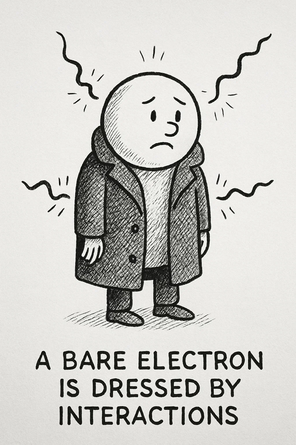
Interactions are complicated
Interactions are complicated. Any writer will tell you that. After all, why do many novels and movies seek to isolate their characters? That is why our heroes don’t have access to cell phones or relatives, because the constraint of having one creates so many possibilities that the writer will need great care to account for so many plot lines.
Instead of throwing in all possible interactions, we introduce them one by one; and pay attention to what the characters of our play, these electrons actually do.